

Ginger Chicken Congee: A Bowl That Heals From the Inside Out
Slow-simmered with bone broth, fresh ginger, and bone-in chicken thighs until the rice dissolves into something silky and deeply nourishing. Grounded in prophetic medicine. Built for the phlegmatic body in spring.
Healing Food as a Deliberate Practice
Congee is one of the oldest healing foods on earth. Known across Asia by dozens of names and prepared in hundreds of forms, it appears in Traditional Chinese Medicine as a remedy for digestive recovery, immune restoration, and postpartum replenishment. In the Arabic healing traditions that emerged alongside prophetic guidance, simple warming broths were offered to the ill not merely as nourishment but as medicine and mercy combined.
This ginger chicken congee was not assembled from wellness trends. It was chosen deliberately, in early spring, for a specific body type, for reasons rooted in both classical Islamic humoral medicine and the practical wisdom of centuries of healers. Understanding why this bowl was designed the way it was is part of what makes it something more than a recipe. It becomes a practice of attending to the body with the same care and intelligence you would bring to any other form of healing.
If you have ever felt a particular heaviness entering spring, a low energy you could not shake, congestion that lingered past its season, a digestion that felt sluggish despite eating well, this bowl is a direct response to that experience. The reasoning behind it is below. The recipe itself follows from that reasoning, not the other way around.
The Phlegmatic Body in Spring
Islamic humoral medicine, developed and refined over centuries by physicians including Ibn Sina and Ibn Qayyim al-Jawziyyah, identifies four temperaments or constitutions. Each is defined by a combination of the primary qualities: hot, cold, moist, or dry. Understanding your dominant temperament allows you to choose foods, timing, and practices that keep your body in balance rather than fighting against its own nature.
The phlegmatic temperament is cold and moist in quality. It tends toward calm, steadiness, and a rich interior life. It also tends toward heaviness, slow digestion, and a lower metabolic fire than other constitutions. The phlegmatic body is not broken. It simply runs on a different system, one that responds best to warming, stimulating, drying foods rather than the raw salads and cold smoothies that modern wellness culture often promotes as universally healthy.
Why Spring Specifically
According to Islamic and Galenic humoral medicine, spring is the season in which phlegm (balgham) naturally accumulates. The cold, wet quality of the transitional season mirrors the cold, moist quality of the phlegmatic constitution, which means even non-phlegmatic temperaments may notice phlegm-related symptoms in spring: sluggishness, congestion, brain fog, slow digestion, low motivation. For the phlegmatic specifically, this is the season of greatest challenge and greatest need for warming, drying, digestive support.
Hot + Moist
Sanguine
Energetic, warm, social. Benefits from cooling and moderating foods. Peak season is spring into summer.
Hot + Dry
Choleric
Driven, decisive, quick to act. Benefits from cooling and moistening foods. Peak challenge is summer heat.
Cold + Moist
Phlegmatic
Calm, steady, reflective. Benefits from warming, drying, stimulating foods. Peak challenge is early spring.
Cold + Dry
Melancholic
Thoughtful, cautious, detail-oriented. Benefits from warming and moistening foods. Peak challenge is autumn.
Every element of this congee works directly against the cold-moist excess of the phlegmatic in spring. Ginger is classified as hot and dry in the second degree by Ibn Qayyim, which places it as a direct counterbalance to cold and moist phlegm. Bone broth is warming and deeply nourishing without burdening the digestive fire. Ghee carries warmth into the deeper tissues. The egg provides heat and protein that does not slow digestion. Even the long, slow simmer concentrates the warming qualities of the broth rather than diluting them.
You do not need to be phlegmatic to benefit from this bowl. If you are entering spring feeling heavy, congested, foggy, or slow regardless of your usual constitution, those are signs of seasonal phlegm excess. This recipe addresses exactly that.

What Each Element Gives the Body
Nothing in this bowl is arbitrary. Every ingredient was chosen for the specific quality it contributes to a body that is cold, moist, and in need of warming movement through the sluggish weeks of early spring.
Bone Broth
Rich in collagen, gelatin, and minerals. Restores the gut lining, supports joints, and nourishes deeply without burdening the digestive fire. Warming, restorative, easy to receive even when the body is depleted.
Fresh Ginger
Hot and dry in the second degree. Directly counterbalances cold-moist phlegm. Moves stagnation, stimulates digestion, calms nausea, reduces inflammation. The only spice mentioned by name in the Quran.
Bone-In Chicken Thighs
The bones and dark meat release collagen and gelatin over the long simmer that breast meat cannot provide. The fat is part of the medicine. Do not substitute a leaner cut, especially for the phlegmatic, who needs the warming, fat-soluble nutrients.
Ghee
A carrier of warmth revered in both Islamic medicine and Ayurveda. It reaches the deeper tissues, nourishes the brain and joints, and draws the qualities of the food it accompanies more fully into the body. Stir it in at the very end to preserve its full benefit.
Sweet Potato
Optional but grounding. Adds warmth, natural sweetness, and a gentle fortifying earthiness that provides slow-releasing nourishment without spiking and crashing. Particularly beneficial for the phlegmatic who also tends toward low sustained energy.
The Slow Simmer
The method is itself medicine. Low heat over a long time extracts from the bones and grain what speed cannot. The rice breaks down so completely it becomes part of the broth. This is why the congee cannot be rushed without becoming something categorically different.
Now That You Know the Ingredients: Their Place in the Prophetic Tradition
Each of the ingredients above, chosen for their humoral and nutritional qualities, carries an additional layer of significance within the Islamic healing tradition. Tibb al-Nabawi is not a fixed list of prescribed foods. It is a living framework rooted in the Quran and the Sunnah, developed by scholars who understood the body, the spirit, and the relationship between the two. The ingredients in this bowl are not in it because they are fashionable. They are in it because they have been trusted for over a thousand years.
It is worth noting here: this is not a recipe directly sourced from hadith. The claim is not that the Prophet instructed us to eat chicken congee. The claim is that the specific ingredients chosen for their healing properties in this bowl align with the prophetic tradition's own understanding of what the body needs, and that eating with awareness of that lineage changes the quality of the act. The words of the tradition are offered below to be received in that spirit.
Ginger in the Tradition
Ginger appears in the Quran as a flavouring of paradise, the only spice given this distinction. In Zad al-Ma'ad, Ibn Qayyim devotes specific attention to ginger's ability to counteract phlegm, warm the stomach, and restore movement to a sluggish digestion. He describes it as resolving mucus, softening the belly, and strengthening the liver when it has become cold. These are precisely the conditions the phlegmatic faces in spring.
Broth as Prophetic Remedy
Talbina, a simple barley broth the Prophet recommended for the ill and the grieving, establishes a prophetic principle rather than a single recipe: simple, warming, easy-to-digest liquids restore the body gently when it cannot bear more. Bone broth carries this same function in this bowl. It nourishes without burdening. It warms without overwhelming. It is medicine that tastes like care.
Ghee Across Traditions
Ibn Sina describes clarified butter as warming and moistening in quality, a carrier fat that helps the body absorb the beneficial properties of the foods it accompanies. It appears in Ayurvedic texts as a vehicle for deeper healing, in classical Islamic medicine as a strengthening fat for the brain and joints, and in prophetic practice as a blessed food. Both traditions reach the same conclusion by different routes.
Ingredients
Choose the best quality bone broth and chicken you can find. The quality of your ingredients determines the depth of the medicine in the bowl. Homemade bone broth that gels solid in the fridge is the ideal. If using store-bought, choose one with a short ingredient list, no additives, and a rich, gelatinous texture.
The Base
Aromatics
To Finish
Optional
How to Make Ginger Chicken Congee
Rinse the Rice Thoroughly
Place the rice in a fine-mesh sieve and rinse under cold running water until the water runs completely clear. This removes the excess surface starch that would otherwise make the congee gluey. A rinsed rice produces a silkier, more flowing result. Do not skip this step.
Combine and Bring to a Boil
In a large, heavy-bottomed pot, combine the rinsed rice, bone broth, whole chicken thighs with skin on, sliced ginger, chopped carrot, and the sliced onion or leek. Bring the whole pot to a full, rolling boil over medium-high heat. Do not season yet.
Reduce to the Lowest Possible Simmer
Reduce the heat immediately to the lowest setting your stove allows. Tilt the lid so it rests askew on the pot, leaving a gap for steam to escape. Simmer for 1 to 1.5 hours, stirring gently every 15 to 20 minutes and scraping the bottom of the pot as you go. If the congee thickens faster than expected, stir in additional hot broth a small amount at a time. You are looking for something between a thick soup and a smooth porridge.
Shred the Chicken and Return It
Lift the chicken thighs from the pot using tongs or a slotted spoon and set them on a board. Discard the skin and bones. Use two forks to shred all of the meat into generous, tender pieces. Return every strand back to the pot and stir it through. This is the moment the bowl becomes a meal.
Add Sweet Potato in the Final 20 Minutes
If you are including sweet potato, stir the peeled, small-diced cubes into the pot during the final 20 minutes of cooking. They add a gentle natural sweetness, an earthy warmth, and a grounding quality that makes the bowl more fortifying for those who need sustained energy throughout the day.
Season Gradually and Finish With Ghee
Taste and season with salt and black pepper in stages, returning to taste each time. Congee absorbs a significant amount of salt. Be more generous than you expect you need to be. Once the flavour is open and full, stir in the ghee and let it melt slowly through the pot. Do not rush this step. The ghee carries warmth into every spoonful.
Serve With a Gently Poached Egg
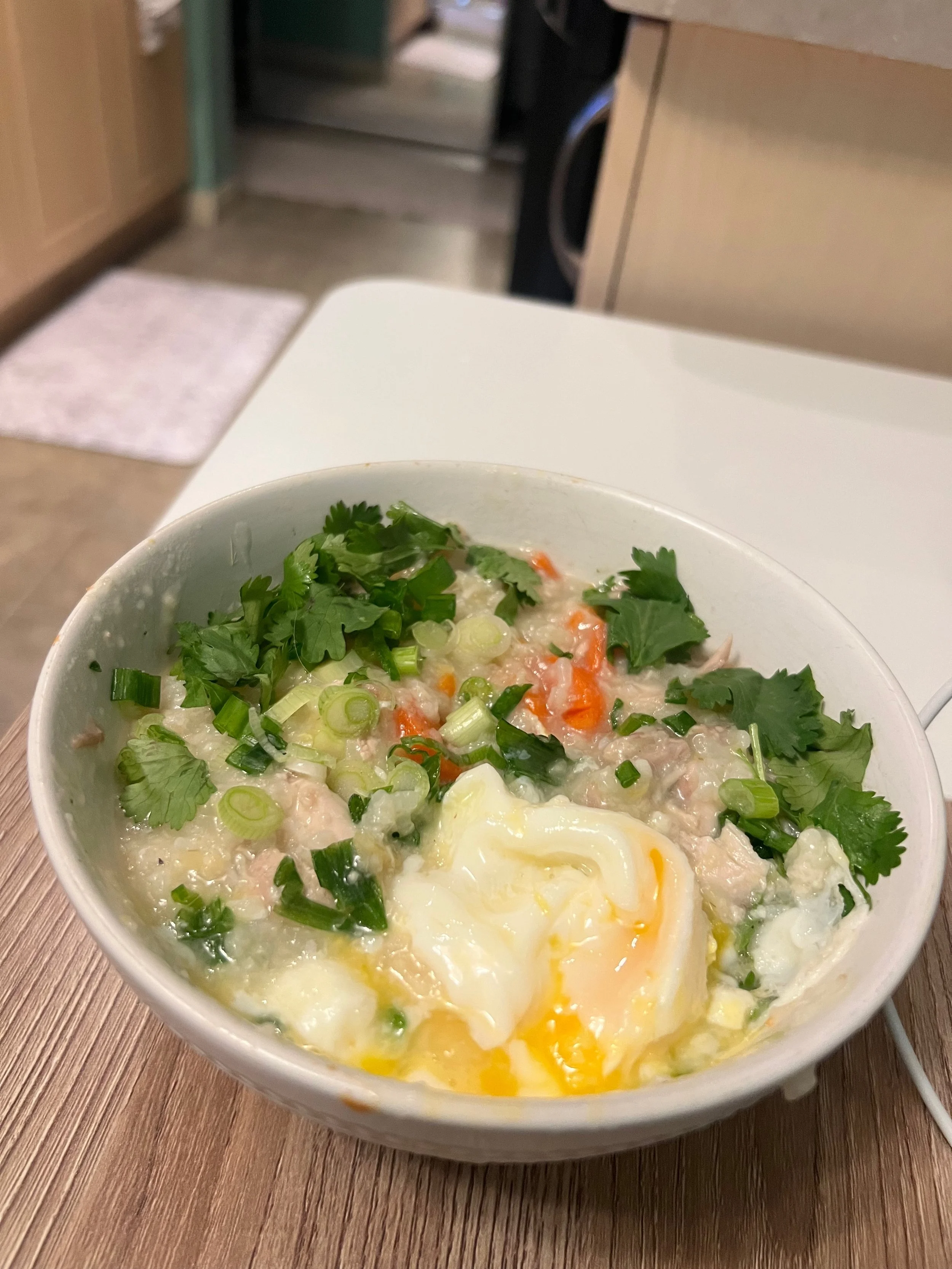
Ladle the hot congee into deep bowls. Crack one egg directly into each bowl while the congee is still steaming. Cover the bowl immediately with a plate or lid and let it sit undisturbed for 3 minutes. The retained heat will gently poach the egg to a soft, silky finish. When you break it, the yolk will run through the bowl and enrich every spoonful. Scatter sliced scallions and fresh cilantro over the top and serve immediately.
On Reheating
This congee thickens considerably as it cools. When reheating, add a generous splash of broth or water and warm gently over low heat, stirring until it returns to your preferred consistency. It keeps refrigerated for up to 3 days and often tastes better on day two.
For a Deeper Bowl
Use a 10 to 1 ratio of broth to rice rather than 8 to 1. The congee will take longer to reach full thickness but the flavour will be extraordinary. Worth every extra minute at the stove.
On the Ginger
Do not mince the ginger. Thick slices steep gently into the broth and give warmth and depth without harsh heat. Remove any pieces before serving if preferred, though most will have softened enough to eat.
How You Eat Matters as Much as What You Eat
You spent 90 minutes making something healing. These six practices take the bowl from a good meal to a complete act of nourishment. None of them require anything unusual. All of them are supported by both traditional wisdom and modern physiology.
Before You Eat
Start With Intention
A moment of gratitude or presence before eating, whether that is Bismillah, a breath, or simply naming what you are about to receive, activates a different relationship with the food. Research on the cephalic phase of digestion confirms that anticipatory attention, seeing, smelling, and consciously preparing to receive a meal, stimulates digestive enzymes before the first bite. Attention is not ceremonial. It is physiological.
Quantity
Stop Before You Are Full
The Japanese concept of hara hachi bu, eating to approximately 80 percent capacity, aligns precisely with what classical Islamic medicine also teaches: leave space in the stomach. The digestive system requires room to move the food. Overfilling it creates stagnation, which is the very condition the phlegmatic is already prone to. A medium bowl eaten slowly and with presence nourishes more effectively than a large one consumed past the point of comfort.
Environment
Eat Without a Screen
Eating while distracted measurably reduces satiety signalling and digestion efficiency. The stomach signals fullness to the brain over a 20-minute window. If your attention is elsewhere during that window, you will consistently eat more and absorb less. Even if you eat alone, set the phone down. This bowl took patience to make. It deserves your full attention for the 15 minutes it takes to receive it.
What to Drink
Avoid Cold Drinks Alongside
Cold water consumed during a hot meal interferes with digestion, particularly for those with a naturally lower digestive fire. For the phlegmatic in spring, this is especially counterproductive. You are eating this bowl specifically to warm yourself up. Drinking something cold alongside it works against that. Warm water is ideal. A simple ginger, cinnamon, or tulsi tea deepens the therapeutic effect of the meal significantly.
After Eating
Rest, Then Walk Gently
A brief period of quiet after eating, somewhere between 10 and 20 minutes, supports the digestive process and reduces the energy demand on the rest of the body. After that rest, gentle walking for 10 to 15 minutes stimulates peristalsis and is particularly beneficial for the phlegmatic, for whom movement is medicine. The combination of rest followed by gentle movement is one of the most consistent practices in traditional healing systems across cultures and continents.
Seasonality
Let the Season Guide What You Eat
This bowl is at its most potent in early to mid spring, when phlegm is naturally elevated and the body is transitioning from the inward quiet of winter toward the outward activity of summer. By late spring and into summer, your body will begin calling for lighter, cooler, more refreshing foods. Follow that call. Eating seasonally is not a wellness trend. It is the oldest nutritional framework in the world, and it works because the body and the season are made of the same cycles.
The Bowl Is the Beginning, Not the Whole
Food is the most immediate lever we have for how the body feels. But it is one lever among many. If this bowl is calling to you, it is likely because something in your body is asking for more conscious attention: more warmth, more rest, more nourishment at a deeper level than food alone can reach. Sleep, sunlight, movement, breath, and time in nature all complete the picture that this congee begins. Eating well, sleeping enough, moving gently, and choosing warmth over stimulation are not lifestyle upgrades. They are the baseline conditions the body needs to heal itself. This bowl is a doorway into that awareness, not a destination.
Three Things That Will Make This Extraordinary
The recipe is straightforward. These three details are what separate a healing bowl from a merely pleasant one.
Broth Quality Is Everything
Use bone broth that gels solid in the fridge overnight. That wobble is the collagen, and collagen is where the medicine lives. If your broth is watery, the therapeutic value of this recipe drops significantly. Homemade is ideal. Store-bought is acceptable if it has a short ingredient list, no additives, and gels when cold.
Do Not Rush the Simmer
A vigorous boil makes the congee starchy, the chicken tough, and the ginger sharp. Keep the heat at its absolute lowest setting. The transformation you are looking for, where the rice fully dissolves into the broth and the whole pot becomes silky rather than grainy, only happens at a slow pace. 75 to 90 minutes minimum. That time is not wasted. That time is the method.
Season Only at the Very End
Salt affects how the rice absorbs liquid during cooking. Season after the chicken is shredded and returned, after the ghee is stirred in, after everything is as it should be. Taste. Add salt in small increments. Taste again. Congee needs more salt than you expect. The bowl should taste alive and full, not flat. Be generous and patient in equal measure.
If this recipe and the traditions it draws from have touched something in you, the deeper work of Sufi Soul Garden holds that thread. We begin with a conversation.
